
SMALL Publication – A/Prof Rachel Ee
- July 09, 2025
- Research Highlights
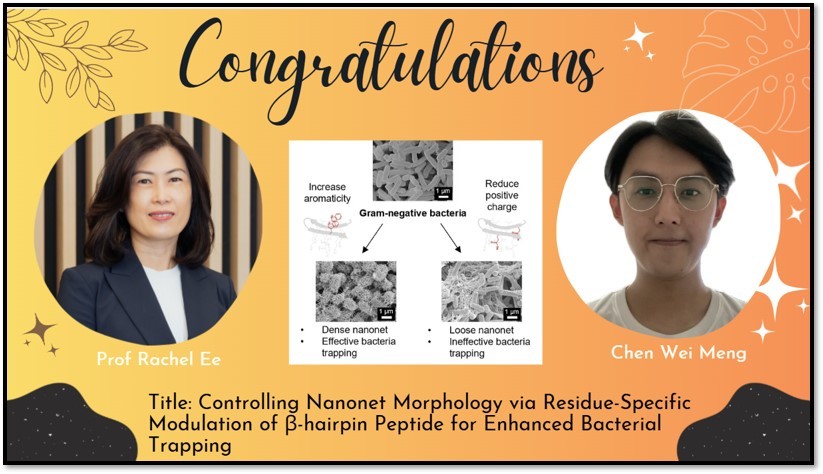
Please join us to congratulate Prof Rachel Ee, Wei Meng and team on their latest publication in SMALL (IF 12.1), titled “Controlling Nanonet Morphology via Residue-Specific Modulation of β-hairpin Peptide for Enhanced Bacterial Trapping ”. The online article can be accessed here Controlling Nanonet Morphology via Residue‐Specific Modulation of β‐Hairpin Peptide for Enhanced Bacterial Trapping – Chen – Small – Wiley Online Library
From Sequence to Function: Modifying the side strands of β-hairpin peptides with aromatic or negatively charged residues enables the tuning of their self-assembly to create bacteria-specific nanonets with distinct morphologies and functions. Tight nanonets effectively encage and kill motile bacteria to reduce post-entrapment escape and spread, while loose nanonets without antibacterial activity fail to contain bacterial outgrowth.
Read more: Weaving peptide nanonets to fight bacterial infections – NUS Faculty of Science