
Nature Communications Publication – Sheng Shen
- October 24, 2025
- Research Highlights
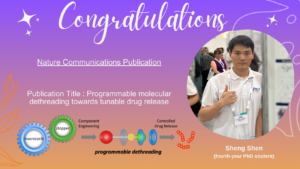
We are thrilled to announce that the paper titled “Programmable molecular dethreading towards tunable drug release” has been published in Nature Communications, with Sheng Shen, a fourth-year PhD student under the supervision of Dr Tian Chong, as the first author. This achievement is the result of a collaborative effort involving Ryan Ray Yen Lee (Year 1 PhD), Yuxuan Gao (former MPST student), Huize Han (Year 3 PhD from Dr. Tang’s group), Zhijun Wan, Calvent Owh, Carol-Anne Ming Yi Chua, Zhen Yu Chong, and Nicholas Wee Hao Ng (all former Pharmacy or PHS undergraduates), along with Dr Tang Wei are co-authors.
Please join us in congratulating the entire team on this outstanding accomplishment!
Pseudorotaxane dethreading offers a means to regulate motion in artificial molecular machines, but achieving predictable and programmable control over dethreading kinetics remains challenging. Here, the authors report systematic modulation of dethreading behaviour through component engineering of a pseudorotaxane platform. By systematically tuning size and shape of the ring and axle components, the author achieved programmable dethreading rates. Mechanistic studies, supported by density functional theory (DFT) calculations, revealed that the dethreading process is governed by a finely balanced interplay of steric complementarity, conformational changes, and noncovalent interactions between the components. Applying this design to a rotaxane-based camptothecin prodrug, the author demonstrated that controlled dethreading directly dominates drug release kinetics and anticancer efficacy.
The online article can be accessed here: https://www.nature.com/articles/s41467-025-64452-5