
The Pharmacist’s Inner Compass: How Self-Compassion Enhances Patient Care
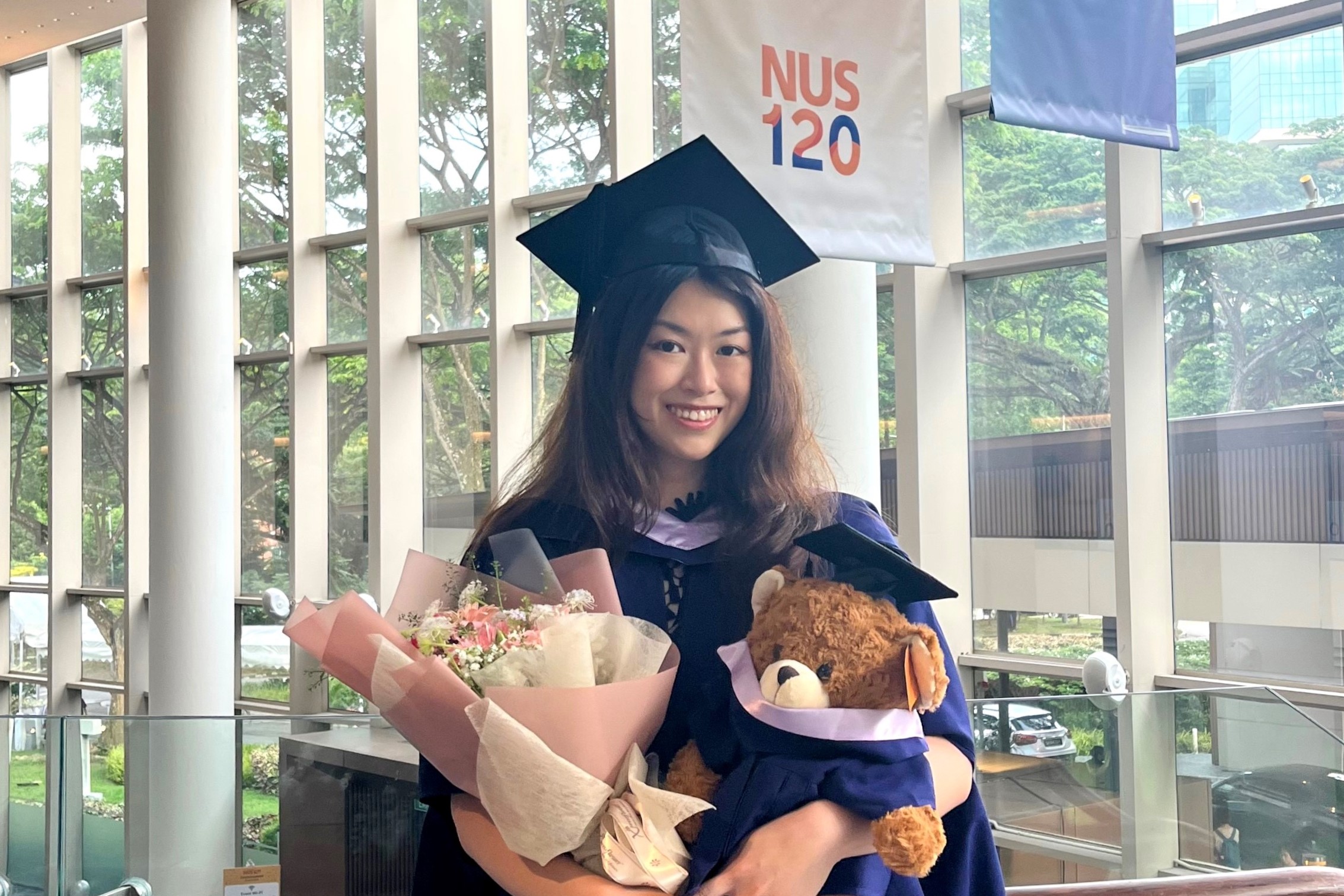
Working as a pharmacist often means putting patients’ needs before your own. Ms Chloe Tan (Class of ’25) understands the significant challenges of burnout and disconnection that many healthcare professionals face today. Having completed her Master of Clinical Pharmacy at NUS as part of the inaugural graduate cohort, she reflects, “If one could practice self-compassion more, it can actually strengthen emotional resilience and build deeper empathy towards patient care.”
This insight prompted Chloe to further reflect on the roles of identity, emotion, and societal influence during her formative years:
A popular trend “I met my younger self for coffee today” has been going around social media platforms, where one would imagine a literal encounter with one’s former self over a cup of coffee. This trend inspired me to express a symbolic conversation that I wrote, which became a reflective exploration of my identity and emotional evolution. Through this lens, I applied the four transformative phrases — “Thank you”, “Please forgive me”, “I forgive you” and “I love you” — not to another person, but inwardly, to my past self. This exercise allowed me to reconsider how identity is socially constructed, how emotional experiences are shaped by societal expectations, and how self-awareness is part of our ongoing socialisation.
In this imaginary meeting, my younger self arrived ten minutes early, energetic and expressive, dressed in skinny jeans and a crop top. I arrived ten minutes late, quieter, more observant, wearing baggy jeans and a crop tube top. Even in these small details, I began to recognise the symbolic differences between us — not just in fashion or coffee preferences, but in social context and emotional expression. My younger self, vibrant and open, represents a pre-socialised innocence, less impacted by the emotional constraints of adulthood. My current self is more reserved, shaped by unspoken norms, expectations, and social experiences. When she asks, “What does our future hold?”, excitement flooded my gaze as I told her about the cities I have lived in and the people we have met. She is surprised by how much we have experienced, in other words, intrigued by the amount of mobility and growth that have occurred. But behind my words lies the emotional labor involved in navigating adulthood, career pressures, independence, and cultural transitions. These are not just personal developments but are also traits that are shaped by institutional and structural influences.
Before we parted, I held her hands and said, “Thank you.” I thank her for holding onto our joy, for not letting external forces erase her sense of play and passion. But within those words, also carried an apology and acknowledgment of guilt. Guilt for the times I traded authenticity for acceptance, freedom for control, and curiosity for caution. It reflected how, over time, I allowed external pressures — of success, appearance, and identity — to shape my choices more than my own values did. When she asked, “Why do I feel like you’re leaving me?”, I felt the need to say, “Please forgive me” knowing what I have been through and the things I have done. That plea for forgiveness was wrapped in guilt — for losing parts of myself in the pursuit of validation, for letting external ideals of success, beauty, and achievement define our worth. It’s something so many of us do without realizing it, until one day we look back and ask: “When did I stop choosing for myself?” In that moment, I was not just apologising for personal choices. I was recognising the quiet, collective pressure that society exerts on identity, and the way it causes us to drift from our younger, freer selves.
In turn, my younger self smiled and said, “I forgive you.” This phrase highlights how we hold onto guilt for past choices, even those made without full understanding. It reflects the concept of reflexive modernity, where individuals constantly re-evaluate their biographies. I forgave myself for decisions made under social pressures, for moments of self-doubt influenced by external judgments and social norms. Finally, I tell her, “I love you.”, expressing it through a tight hug and the longing of not letting her go. Though it may sound simple, this act of self-love is radical within a society that often links our worth to productivity, perfection, or social validation. Loving myself is not just personal healing, it is a sociopolitical act. It resists the depersonalization and alienation, where individuals are distanced from their authentic selves due to commodification and conformity. Me, expressing love for my present and past self, was not just an affirmation, but a reconciliation; a way of honoring who I was, embracing who I am, and promising to carry both with kindness moving forward.
I chose to have this conversation with myself, rather than with someone else, because I realised how often people neglect their relationship with themselves, and are often fixated on the ones they have with others. In our daily lives, we as a gregarious species, are encouraged to nurture connections with others — family, friends, partners — yet rarely are we taught to check in with our own inner world. The four key messages — “Thank you”, “Please forgive me”, “I forgive you” and “I love you” — are most commonly directed outwardly, towards loved ones. But what happens when we turn them inward? That was the question that guided this reflection. Engaging with these phrases internally helped me recognise the emotional residue I had been carrying, unspoken and unresolved. It also gave me space to appreciate the growth and resilience that often go unnoticed when the only lens we use is external validation. In fact, it is often in the later stages of life, where we are forced to look back, that we begin to recognize how much guilt, regret and emotional baggage we have carried in silence. It is only then, do many people seek forgiveness, both from others and themselves, but by that point, the opportunity to heal may feel distinct or lost.
Interestingly, the concept of the four key messages, has made me realise how much easier it is to show empathy to others than to ourselves. Among our daily social interactions, we are conditioned to offer comfort, support, and affection, to say “Thank you”, “I love you”, “I forgive you” and “Please forgive me” when others are hurting or when we inflict pain. But when it comes to ourselves, many of us default to silence, criticism, or emotional withdrawal. This tendency is rooted in the basis and concept of socialisation, even more so within the Asia society, where we are taught to prioritise others, to be “strong” and to mask vulnerability. As a result, self-empathy becomes an afterthought. Yet, if we applied the same compassion to ourselves that we so willingly extend to others, we might break cycles of burnout, self-doubt, and emotional neglect. Sociology concepts teach us that behaviour is shaped by social norms and values, and perhaps it is time we normalise inner dialogue and emotional self-care just as much as outward expressions of love.
Although this reflection was ultimately derived from a trend-inspired imagination, the impact was far from superficial. The four key messages — “Thank you”, “Please forgive me”, “I forgive you” and “I love you” — may seem simple, but they hold the potential for profound healing. They are more than words, in fact they are invitations to deeper self-awareness, empathy, and emotional accountability. If we begin practicing them not only with others but also with ourselves, we lay the groundwork for a future society that values honest reflection, emotional openness, and mutual care. In a world often focused on performance and perfection, conversations like these remind us of the power of presence, authenticity, and the healing that begins when we finally choose to listen to ourselves.
Article by Ms Chloe Tan Jia Ying (Class of ’25)
Share this article:
Stay connected with NUS Pharmacy!
Receive PharmConnect Newsletters & announcements by NUS Pharmacy.